
Monday, April 21, 2014
Monday, August 12, 2013
Performances That Seek to Interrupt: Nigerian Artist Wura-Natasha Ogunji & The Craft of Spectacle
*Interview by Maryam Kazeem, originally
published on the blog okayafrica
 |
| Photo: Ema Edosio |
As they walk through the streets of
Yaba in Lagos, Nigeria Wura-Natasha Ogunji and six women
dressed in matching costumes and masks around their faces, carry kegs
full of water that are strapped to their ankles. Catching the
attention of those they pass on the street, Ogunji describes
the thoughts racing through her mind at the time, “in
that beginning moment i doubted so much. i had to remember the words
i had spoken upstairs. trust, rest, trust. i learned so much in the
first five minutes. walking required my entire body (were we actually
even walking? it felt like something else).” However, this isn’t
the first time Ogunji has performed this act- in 2011 she
crawled along the ground “with water kegs tied to [her ankles] inspired by the daily task of carrying water at [her]
cousin’s house.” In collaboration with the Center for
Contemporary Art Lagos (CCA), in Will I still carry water
when I am a dead woman? Ogunji creates a spectacle out of the
mundane by illuminating certain notions of women and space in Lagos.
In their performance, Ogunji and the
other women are dressed in matching costumes (with an “Afrofuturistic
touch”) for more than just aesthetic appeal, rather Ogunji attempts
to conjure images of the Egungun Masquerade, which women are not
typically allowed to perform. In tradition during the Egungun
masquerade the masked dancer is allowed to travel anywhere and they
are protected (People are not even allowed to touch them); as such,
Ogunji builds on the daily task of carrying water, by simultaneously
“allowing women to occupy a sacred, dynamic, and public space”
through their performance as masked water carriers. In her quest to
evoke dynamics between labour and women, Will I still carry
water when I am a dead woman? is one mere example of how
Ogunji’s work excavates the complexities of the relationship
between women, society, space and politics.
Based in Austin and Lagos, Wura-Natasha
Ogunji is “best know for her videos, in which she uses her own body
to explore movement and mark-making across water, land and air.”
She has received a number of awards for her working including a John
Simon Guggeinheim Memorial Foundation Fellowship (2012). If we
think of performance art as art that “does” in the immediate,
specifically in the space that it occurs, yet also has the capacity
to travel in impact and medium as a consequence- then Ogunji’s
pieces aim to “do” in Lagos. We asked her a few questions about
her recent work- her experiences carrying out these ambitious
performances, the audience engagement and what she has coming up in
the near future.
 |
| beauty performance conceived by Nicole Vlado and Wura-Natasha Ogunji. Image: Ema Edosio |
OKA: Performance art often involves
creating a spectacle. Do you ever worry that people are more focused
on the spectacle rather than the messages you’re trying to convey?
Wura-Natasha Ogunji: I’m
interested in creating a particular exchange between the performers
and the audience. This requires a kind of respect and
consideration for the public which I don’t at all associate with
spectacles. When I think about a spectacle it brings to mind a
particular image or event that is intended to shock. And things
that shock us don’t necessarily create opportunities for
conversations or transformation. I love this question you are
asking because it really gets at the challenge of creating meaningful
performance.
As an artist I am creating certain
parameters and asking certain questions but I don’t determine the
answers and I certainly don’t own the experience. The
collective is incredibly important to this process–be they audience
members or performers or students trying performance for the first
time or a bystander who participates. I expect the audience to
do some work, to ask questions, to figure some things out on their
own. People sometimes ask, what is this about? And my
first answer is always, what do you think it’s about? What
did you see, feel and experience?
I have found people in Lagos to be very
generous. They ask questions. They respect the
performance and the performers. They give a lot. But they
also require a lot because you can see crazy things here on a daily
basis, in any moment. I am very interested in
interruptions and disorientation. The fact that we are women
occupying public space in unexpected ways is an immediate
interruption. I want people to stop to look because they are
seeing something that calls their attention in a particular way–and
not in a violent way. A fight can stop traffic. I want to
interrupt someone’s daily journey with something different. I
want people to stop, to witness, to comment on the work or ask
questions because they feel drawn to it, pulled by it in a way that
expands the imagination.
OKA: You mention that a lot of your
work is done through your body as a way of understanding larger
questions of how bodies engage with space. Are you also
addressing more abstract notions of space (diaspora) particularly as
someone who lives in the U.S. and Nigeria?
WNO: Yes, absolutely. My
previous video and performance work definitely considered larger
spaces of the diaspora. I was particularly interested in the
Atlantic as a site for memory, history, creativity. The
videos I made including ‘The epic crossing of an Ife
head’ provided a way for me to explore this space between
Africa and the Americas. I began that series because I
had a question about this relationship. I asked “Does homeland long
for us?” In answering that question I thought about the
physical efforts that the Ife head would have to go through to find
her descendents in the Americas. In order to cross the Atlantic
she must either fly or walk on water. Taking on that persona of
the Ife head I attempt to fly by jumping into the air. I
saw the physicality of that act as akin to the efforts required to
make that connection across space which is really across that
enormous ocean. The journey is also about moving through one’s
history–both personal and collective.
Now that I am in Lagos my questions
have, of course, changed. I can say that homeland indeed longs
for us which I understand to mean that there’s a place for me here
in this present moment. And now my engagement with the body
(both my own and others) is affected by this particular urban space
in which I find myself.
OKA: What has the response been to your
recent pieces, beauty and Will I still carry water
when I am a dead woman?
WNO: People always have a lot of
questions. With beauty the five of us had our hair
braided together and we stayed that way for four hours. There
were people who said we wouldn’t make it, that we wouldn’t last
the four hours. There was someone in the audience who talked
about how this piece was for Nigerians. I understood that to
mean that the person not only felt a connection to the work but that
they thought it had relevance to this place and people specifically.
My favorite response was a conversation with a young girl, perhaps
she was 9 years old. She asked why we had done the performance
and then I spoke with her about the connections we have as women to
our hair and the even more important connections we have to each
other. She understood that of course, she feels it too.
Will I still carry water when I am a
dead woman? was different. We were masked during the
piece. I heard a lot of comments about our strength. A friend
told me that someone asked why we would be carrying water kegs
through the streets if we were not getting paid. There was also
a woman who thought we were being punished and that the punishment
was too harsh. One of the performers, Wana Udobang wrote
abouthow the piece brought into focus the ways in which we, as women,
place burdens on ourselves and that in the end no one else even
acknowledges our work, they stop even noticing our struggles.
She observed that by the end of the walk through town people began to
almost ignore us as they went back to their daily lives.
 |
| Audience after beauty performance. Image: Soibifaa Dokubo |
OKA: Did you notice anything that your
audience was doing while watching the performances that you found
particularly interesting or even strange?
WNO: beauty was an incredible
experience because we were in the middle of Obalende Motor Park.
Hundreds of people passed by during the four hours that we were
performing. They were watching us and we were watching them as
intently. As performers we all spoke about that experience.
We talked about even wanting to film the audience watching us.
It’s an incredible feeling, to be witnessed in this particular way
by strangers and to also be in a position to really take in another
person’s presence, someone you don’t even know.
OKA: What projects do you have coming
up in the future?
WNO: I’m in an exhibition with
two other artists (Ruby Onyinyechi Amanze and Nnenna Okore) called
‘No one belongs here more than you‘ which opens at the Centre
for Contemporary Art, Lagos this June. I will show a new
video installation as well as documentation of the performance
works. I’m also creating a performance for the opening that
draws from the tradition of bowing and prostration.
***

no one belongs here more than you

Centre for Contemporary Art, Lagos
#9 Reverend McEwen Street, Sabo, Yaba
June 15-September 14, 2013
works by Ruby Onyinyechi Amanze, Wura-Natasha Ogunji, Nnenna Okore
Queens
Performed
by Folashade Adebayo, Kemi Aderinto, Taiwo Aiyedogbon, Ruby
Onyinyechi
Amanze,
Simi
Dosekun,
Ema
Edosio, Kimberli Gant, Wura-Natasha
Ogunji, Mary Oruoghor and an Anonymous Stranger

We
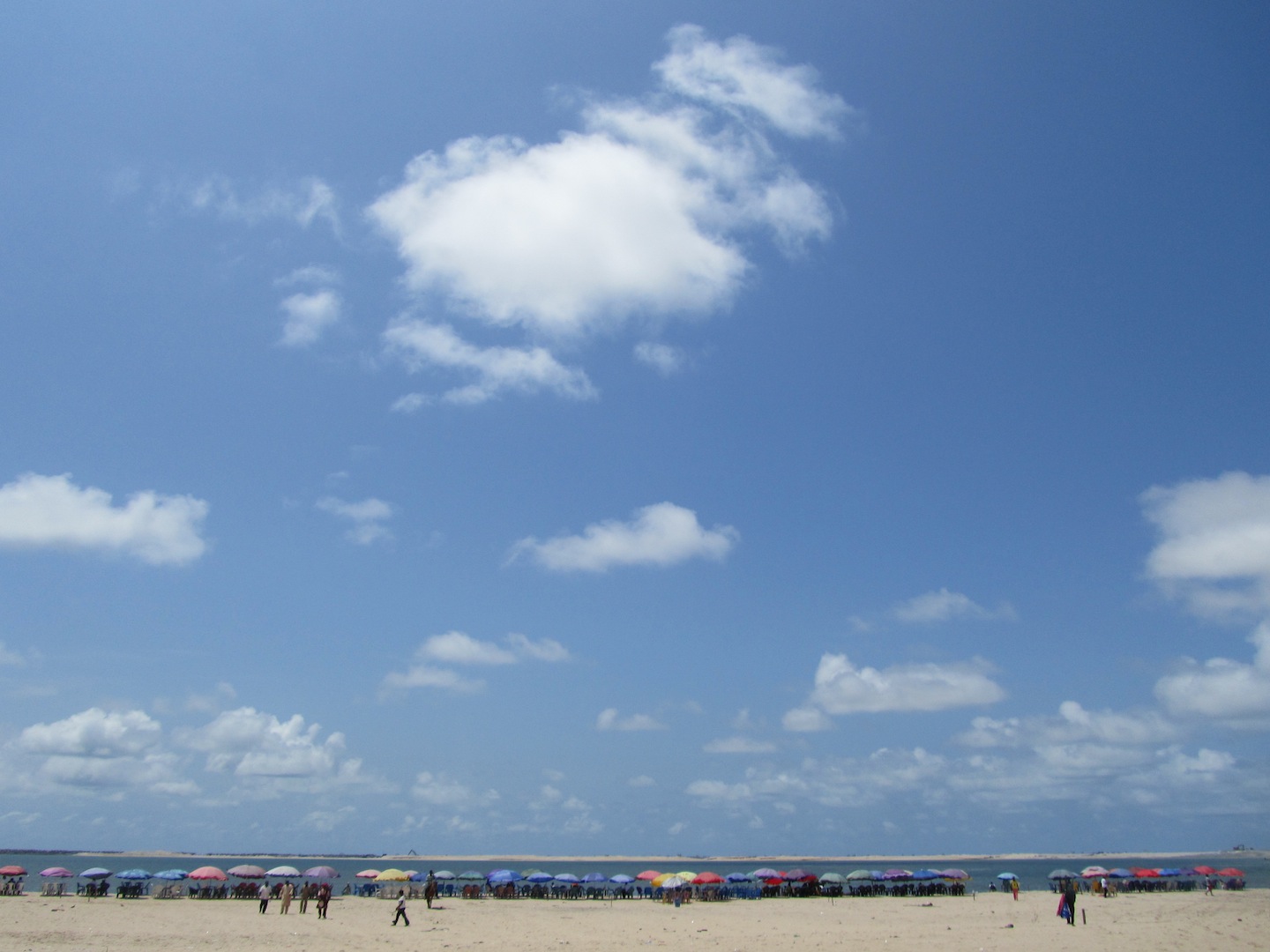
are facing the sea. It is a cloudy day at Bar Beach and we are
sitting on raised platforms looking out over
the Atlantic. This place is fast becoming Eko Atlantic, a planned
extension of the city constructed on reclaimed land; developers
describe it as 'the new
financial epicentre of West Africa.' It feels like a science fiction
novel--creating
land from sea. A god-like arrogance fuels the project. Humans are
drawn to epic feats and Lagos is a city of extremes and exaggeration,
so why not here? City workers tend the sand. Police officers sit
waiting. They will yell at anyone who attempts to walk onto the
beach, especially lovers who dare to take photographs by the shore.
This place is only open for public holidays and barely even that.
Such
a feat does not happen in a vacuum of course. In August of 2012 an
ocean surge pulled 16 people to their deaths and flooded parts of the
island. Scientists and critics attributed the sea swell directly to
the project. And earlier this year a teacher tells me of how her
student is now homeless because of the Eko Atlantic. Bulldozers came
to remove the shacks on the beach and now many people are without
shelter. The arrogance of politicians and businessmen. I have never
understood this, the math of people's lives, that you can exchange
one thing for another as if they are equal, as if Eko Atlantic is
greater than or equal to the dignity of humans, is greater than or
equal to homes, is greater than or equal to the efforts of a father
who lives on the beach with his family and works hard to send his
child to the French school because he knows it will make her life
better than his own. Greater than or equal to. Humans are so
terribly arrogant. Or perhaps it is pure lack of imagination that
prevents the developers from taking care of the people affected by
the project.


 |
| Image: Ema Edosio |
And
then there is us, Queens, a group of four artists making performance
under a cloudy sky. It began with a story. I asked artist Ruby
Amanze to write a score or directions or impressions about Nigeria
that would become a public performance piece. (See Palestinian
artist Emily Jacir and American artist Clifford Owens). Ruby writes:
I
think about worship. What it means to worship something or someone. I
think about worshiping oneself. Being god-like somehow. I see a
throne. Women can’t sit on those here. But what if? And a crown.
Something about wrapping your hair with one of those traditional,
elaborate, crunchy fabric headwraps. But the fabric is super long.
Awkwardly long and maybe heavy. And the wrapping takes forever and
makes your arms tired. And then your head gets a little wobbly as a
result of the weight. But it’s still a crown.
For
the performance we sit on raised platforms wearing sky-high crowns.
We are queens for a day, attached to each other by a length of aso
oke. The crowns are awkard, they wobble on our heads. They
are at once regal and not. Ruby and I begin the piece. After
about an hour we trade places with two other performers, students
from Yaba Tech who are now fully committed to the practice of
performance, Mary and Taiwo. We fit the crowns to their heads and
step down onto the beach.


My
friend Connor walks up and asks for the name of the gele knot near
the top of the crown. My sister, Folashade has tied it. She replies,
Afojusoko, face the husband. He laughs, let's call it Afojusokun,
face the sea. I love my people.
I
ask Ruby what the experience was like for her. “Facing the sea I
was thinking, this is all mine.” I was thinking the same thing.
But we are thinking so much more. This is all mine. I am thinking
about history and conquest, the slave trade, colonization, land,
property. But more importantly I am thinking, “This is all mine,
meaning what I see and what I imagine is all mine. I can make it
whatever I want it to be.” And in this pause from the chaos of
Lagos, we are here staring out at the sea and while we wear these
crowns whatever we imagine is ours.
Other
women wear the crowns throughout the afternoon. One of the beach
police officers is extremely excited when I ask her if she would like
to participate. And later a stranger sits confidently with the
wrapped fabric atop her head. She is quiet and smiling.

Near
the end of the performance Ruby and I once again wear the crowns. We
decide to stand up during the final moments. There is commotion on
the beach. My sister tells me that there is an oga that is higher
than the police officers we bribed. He works for Lagos State and
wants us to stop performing immediately. From the raised platforms
Ruby and I stare at each other. The small arguing crowd comes
closer. We hear the oga say, “I don't want you to get the
impression that I'm a bad man.” One of the police officers says
it's time to come down. I look at the non-existent watch on my
wrist. Ruby and I are still staring at each other and now we are
laughing. I'm wondering if we will be physically pulled off of the
platforms. It's about 5:35pm now. I actually thought we might get
kicked out much sooner. We continue laughing while also maintaining
our composure. We are queens after all. Someone in the crowd says,
“They're praying.” This brings the arguing to a halt for a
moment and buys us time. “Oh, they're praying, well, let them
finish praying and then they can come down.” More laughter from
the queens.
 |
| Image: Soibifaa Dokubo |
A
friend see the photographs from the performance. She couldn't be
there but is so excited about the piece. She tells me, “You know
women go through so much in this society, but I love how when a woman
puts on that crown, in that moment she feels untouchable.” That's
exactly what it feels like to face the sea while wearing a crown that
is connected to another woman wearing a crown and facing the sea.
Untouchable.
***
Friday, May 10, 2013
a friend tells me he's glad that people are afraid of lagos. i feel relieved and excited that someone else feels the same way that i do. this place is not for everyone. he says, i don't want everyone to feel comfortable coming here. i think about something my brother said, the world is what it is, you have to give back what it takes from you. how beautiful. you have to give back what it takes from you.
sounds like something a samurai would say.


 you can't freely take a photograph of someone in lagos. this reminds me of one of my first experiences filming in nigeria, at a market in abuja. i was entranced with a group of women sitting around a lone tree at the market. once you pass 30 seconds of filming it is too much, people begin to notice. a woman ran towards me and pushed the camera out of my face. of course. i saw it coming. she tried to curse me. i held my fingers in a similar formation up in her face. this filming was not right, but i couldn't let her put a spell on me. that experience was so important. people notice you here, they see you, for better or worse. it isn't like the u.s. where people coldly pass by
pretending you don't exist. nigerians will never pretend that they don't see you with your camera. they will never pretend you aren't there.
 a filmmaker talks about how frustrating it is to always have to pay people. if i am hearing correctly, he suggests that it makes filmmaking lose some of its poetry because you are always negotiating capital in the process. i can understand this. but asking for something in exchange for a photograph is important. i see it as a refusal: i refuse the taking of my image to be used by you. i like that people don't just allow their image to be taken, to travel far and wide, to be used outside of the scope of their own lives. (these are not photographs taken for weddings, funerals, or the simple vanity of a self-portrait snapped with a phone on the way to school, on the bus, on okada because you know you look damn good and want to archive that, want to post it, want to look at your own fine image endlessly scrolling through pictures on the blackberry). taking a photograph carries with it responsibility. it must be an exchange.
the samurai would also say, you have to give back what you take.
 a photographic conundrum. i'm not exactly sure when it happened--when i noticed, felt the limits of the single image. i am always taking photographs, but rarely, rarely show them. i wonder if the single photographic image is even interesting anymore. can it draw us in and disorient or re-orient enough to be exciting, or more importantly, relevant? and relevant in a way that causes action (whether in thought or response). currently, the moving image solves this problem for me. it is photographic of course, but not fixed. and people are not fixed when they are moving. they remain whole, dynamic.
 i made a video a couple weeks ago with my phone. a group of rollerbladers wait under bridge for danfo. as i enter the bus, one catches the window. i am filming him negotiate the traffic. he is awesome. i watch the footage endlessly. i have a mission to find him before i leave lagos, to give him photographs of himself, a collection of stills that i have excerpted from the moving picture. i want to thank him for being different and unafraid, for giving back all that the city has taken, for being free in this place that is not for everyone.


Monday, May 06, 2013
Queens

Queens. a performance by Ruby Amanze and Wura Ogunji
Saturday, May 11
Bar Beach 2-6pm
The
performance 'Queens' was developed and inspired by the following
writing from Ruby Amanze.
I think about
worship. What it means to worship something or someone. I think about
worshiping oneself. Being god-like somehow. I see a throne. Women
can’t sit on those here. But what if? And a crown. Something about
wrapping your hair with one of those traditional, elaborate, crunchy
fabric headwraps. But the fabric is super long. Awkwardly long and
maybe heavy. And the wrapping takes forever and makes your arms
tired. And then your head gets a little wobbly as a result of the
weight. But it’s still a crown. Somehow. An invisible one because
there is no actual fabric. Just the action of wrapping. OR an actual
super long fabric. Maybe long enough for two people to wrap their
heads at the same time from the same fabric. Like a mirror. Or
someone else to wrap your head? Either way, at the end you still
manage to balance yourself. Delicately. But with some obvious strain.
There is an elevation of sorts. A ladder? A step? Being prostrate is
such a beautiful position to be in sometimes. A way to worship
something higher…or lower, like the earth. I think about a woman
that has a boy inside of her. But I’m not sure how to show that
visually. Maybe the wrapping is done by a boy? There is something
about a visual balance. Confict. Duality. The chief eve is part boy.
Graceful but choppy. Abrupt. Heavy. Delicate. Women here are all
woman. It’s all or nothing. Yes and no. Black and white. But what
of a diluted woman? A slightly less woman concentration but still
capturing the gentleness. The fluidity. The ability to seduce. And to
kill.
So in summary: Queen. God. Worshiping
self. Elaborate heavy crown. No crown at all. No one worshiping.
Duality. Harmony. Dilution. Balance. Graceful. Choppy. Abrupt.
Awkward. Delicate. Boy inside woman. Elevation. Prostrate.
***
Wednesday, May 01, 2013

Thursday, April 25, 2013
'Will I still carry water when I am a dead woman?'
 |
| Image: Ema Edosio |
from
an email i wrote to another performer a few days after 'Will I still
carry water when I am a dead woman?'
(saturday,
april 20)
your
words are so important, changed something in me, opened something.
i
have been wanting to write about this performance but my body has
felt so exhausted. i know i wrote in my journal but it wasn't enough
and i haven't looked back at it again, and my mind keeps returning to
two moments (one of fear and one of survival...will write about
below). at the same time i felt/feel (as i did with beauty) 'now you
can do anything'. and yet i have this strange exhaustion which i hope
will pass soon....i imagine it's a combination of continued lack of
sleep due to wavering electricity + hot nights + mosquitos. the piece
itself was exhausting too...but can i be feeling it only now?
i
think you and i talked later that day about doing the performance
again (with more people) did that conversation really happen? i know
i was in a daze.
your
email reminds me of so much i was feeling. i think i mentioned this,
but this performance was the first time i felt that i might not be
able to do this. i was worried about everyone else. i didn't check my
mask's eye holes. i didn't test the weight of the water in my own
kegs. i didn't take the time to cut thicker pieces of fabric for
myself which i intuitively knew i would need. once we crossed the
street i thought, oh fuck, i totally fucked up. this will take an
eternity and i will be way behind the others and i may not make it at
all. pulling the water kegs by the ankles was intense (i too had that
same feeling about the strength of my legs...i knew my legs could
carry me and these kegs. after all, i had crawled with water kegs
before). but somehow the mask, which made it hard to breathe, and the
amount of water really terrified me. i have always relied on the
strength of my body. even as a young child i would challenge people
to races, including adults. i always knew i was a fast runner. i
could trust that strength.
and
yet in that beginning moment i doubted so much. i had to remember the
words i had spoken upstairs. trust, rest, trust. i learned so much in
the first five minutes. walking required my entire body (were we
actually even walking? it felt like something else). i had to throw
my arms ahead of me in order to garner the force to move. and there
were many moments when i lost my balance, it was awkward, it felt so
awkward to move this way. the fabric cut quickly into my ankles and i
couldn't help but think about slavery, slave ships, it was a
momentary flash that i quickly tried to dispel from my vision.
the
water kegs bumped into each other. i would pull with all my strength,
only to have one keg slide up against the other, momentum lost. in
that moment i thought how unnecessary it is to struggle. struggle is
a waste of energy, it does not necessarily produce results. it can
exhaust us and leave nothing in the end. how ironic. even after all
that work i arrived at the finish with one keg completely empty of
water. i had hoped it would leak out much sooner. and this was not
the keg on my right side that had been leaking so slowly from the
beginning. this was the keg on my left side. it remained totally full
until the last street. it was heavier that the other one the entire
way and it gave me no relief. and yet when i was almost finished with
the performance the water completely drained out. that was
disatisfying. i had journeyed so far, i should at least have water to
show for it. this was a lesson about struggle. 'struggle for what'
fela. ah. 'now your fault be that'.
 |
| Image: Ema Edosio |
(sunday,
april 21)
you
asked yourself, “am i a masochist?”. i thought about that
question, about the relationship of pain to pleasure and what it is
about it that makes us feel alive. controlled pain. also, the performance
was intimate but i think it was more self-intimacy if that makes
sense.
there
were even moments when i thought i should wait but where i went into
a deep survival mode decision. there were times when i was thinking,
if i stop now i won't make it and i must make it, even if the others
do not, i must. different from beauty where the physical connection
was so absolute, certain.
ALSO,
read Wana
Udobang's response on her blog
Will I still carry water when I am a dead woman?

I
created the first version of 'Will
I still carry water when I am a dead woman?'
in 2011 in Lagos. I crawled along the ground with water kegs tied to
my ankles. The piece was inspired by the daily task of carrying
water at my cousin's house. I observed how this particular work was
largely something that me and my female cousins performed. This is
not to say that men do not do this task.
The
performance on April 18 built upon this work but was performed with a
group of women walking through the streets of Lagos, again hauling
water kegs. While the piece poses questions about the work of women,
it is also about labor and the politics of change. How much is
enough? What is the tipping point in a society where people struggle
to meet basic needs? When do people have an opportunity to rest,
reflect, envision, imagine, and enact another way of being? I am
particularly interested in the role of women in these dialogues.
The
costumes refer to traditional masquerades but with an Afrofuturisic
touch. Here, I am thinking about the Egungun masquerade which women
are not
allowed to perform. Masquerades are quite powerful for both
community and performer. The masked dancer is allowed to go
anywhere; they are protected. People are not allowed to even touch
them. There are men who holds sticks, the cane men (and use them) if
you attempt to get too close. 'Will
I still carry water when I am a dead woman?'
draws from this tradition by allowing women to occupy a sacred and
dynamic space within the public environment. But in this case, there
is a constant movement between or perhaps confusion about the sacred
and the profane as we perform the arduous (if not impossible) task of
hauling water kegs through the city.
Saturday, April 13, 2013
beauty
 |
| Photo: Ema Edosio |
(saturday, april 13)
my
friend Lyndon gave me a journal for my trip to nigeria. on the inside
cover he wrote: create
fearlessly, love openly, make sacred spaces everywhere.
all this intersects with jelili's 'egungun method'. egungun may go
anywhere. there is no place egungun isn't allowed to be. this is
critical. nicole was here this week. she said she had been thinking
about the ulay and marina performance piece, relation in time, 1977.
we began discussing possibilities for here in lagos. women with hair
braided behind their backs. connected. public space. 4 hours.
obalende.
later
in the week we are talking and nicole speaks about wanting the
braiding to be part of the piece itself. so it happens, april 11,
thursday, obalende motor park. everything flows when there is trust
and action. i meet tope the day before the performance. she does
nails and eyelashes under the bridge. i explain the project and she
says she will gather the women to do the hair. we show up on
thursday (i bring the hair) and meet the women. they seem excited
about the piece but are not happy about standing in the sun to braid.
we explain that we are artists and the performance has to happen in
this place. just before we go to the place near the brt buses, one
woman adamantly asks for more money. she is annoyed. i speak with
the head woman who is dressed in this lovely pink. she is gorgeous
and friendly. i agree to pay more. they set up the chairs. we are
side by side for the braiding that begins at 2p.
 |
| Photo: Soibifaa Dokubo |
the
order of the chairs: deola ruby coco veronny wura
people
are watching us already. the braiding hurts. the women are not
gentle but they say “sorry”. veronny tells me how one woman says
(in igbo or yoruba) that she's lucky she got veronny because it's
only about 6 braids. my woman isn't happy because my hair is very
slippery. nicole later tells me that it hurts her head a lot. we
are both tenderheaded and the women braiding hair are ripping her
hair as they go. i am thinking it will feel so much better when we
get to stand. i can't wait. even before we are finished braiding a
group of men (city workers/lagos state something) come over. they
want money. they speak about how we should have taken permission to
be in this place. i have already given connor money to 'settle' them
if need be. they are harassing the women. i stand to speak with
them but they aren't even very interested in what i have to say.
veronny is amazing. at some point soon after this ruckus she says,
“no, i wouldn't pay them anything!” she is always so clear and
vocal. “we are artists. we have a right to be in this place for
artistic expression!”
these
words give me more strength. i know that public space is always
contested here. everyone wants to get paid. connor comes over and
asks how much i am willing to part with? he says they want 10,000
naira. i have only given him 2k. after veronny speaks i tell him
“nothing, do not give them anything.” i trust this will work out
and that we have a presence equal or greater to that of the men who
want a bribe.
 |
| Photo: Soibifaa Dokubo |
 |
| Photo: Soibifaa Dokubo |
we
started at 2p and by 3p we are finished with the braiding. while
getting our hair made, my favorite moments are:
(1)
two girls are watching us. blue checked school uniforms. they are 7
or 8 years old. one has her arm wrapped around the shoulder and neck
of the other. they stare from about ten feet away. they are in a
deep discussion about what they are seeing.
(2)
a group of schoolgirls in blues and skyblues gathers to our left. on
the pile of small stones. there are about 15 of them, 7-10 years
old, 6 feet away. they watch and discuss for quite a long time. they
give us energy.
 |
| Photo: Soibifaa Dokubo |
it
is time for the connecting to happen. our chairs are put into a
circle and the women begin attaching our braids. when it is time to
stand my neck is uncomfortablely hyperextended. i wonder if they have
connected us too closely. we adjust. it is uncomfortable. i will
settle into the discomfort and eventually the pain. we are five but
i can only communicate with the two right next to me. deola to my
left and veronny to my right. i start by facing the radio tower
direction. veronny says, “wow, this is powerful”. around 4pm
during the piece she asks if we can finish early. i am thinking 'no
way'. i tell her to go inside her mind. we have agreed ahead of time
to make small rotations in order to adjust perspective, move a bit
and also to give breaks from the direct sunlight. we speak only a bit
about it. “do you need to move?” we grab hands and slowly rotate
1/5th
of the way around.
veronny
speaks to me and nicole. she is vocal about the pain and exhaustion.
i feel responsible but i am only one of five. i don't ultimately
have the power to stop the piece even if i wanted to. her words
begin to make the exhaustion worse. i tell her to be quiet, to try
that out. we are perhaps pissing each other off. i go into my mind.
at around 4:15/4:30 i am looking between the radio tower and the brt
buses. i am beyond pain and fatigue. my eyes are no longer people
watching. they are taking in everything and nothing. i am this
piece, these 5 women, i am these artists, i know in this moment,
post-pain, that i can go on forever. it is like running, my 3 mile
mark, now i can go all day. it's decided. my neck is still being
pulled back by the weight of the hair. i adjust in small shifts. it
is painful. i try to make myself more comfortable, knowing that
perhaps i will make one of my sisters more uncomfortable. i can't
see them or talk to check in. i have to trust that they will take
care of themselves.
i
see my sister and brothers arrive in the audience. and efiom burns.
it gives me such strength to see familiar faces. they are witnesses
to this. to my life. to our presence. they will remember this one day
and i can go to them for the story if i need to confirm it, just to
know that it happened.
i
don't want to write about the australian guy who was videotaping
because that is not an important part of the story. and it is not
what i want to focus on, though if i let myself his presence will
leave a bitter taste in my mouth. he is filming with a huge mic and
windscreen. at first i am happy to see more cameras--the archive of
all of this is so important. but he doesn't respect the piece itself.
he asks to interview me. he is excited. i say, “at 6pm i will talk
to you.” he is up in our faces with his camera. unlike ema and
soibifaa, he does not respect the power of the piece. at one point
he says, “i don't know about you guys, but i'm having a great
time.” no more white people archiving (i did not invite
him by the way). connor tells me how the meaning of the piece
changes with his own presence as a white man. and also this
australian dude. people think it is a shoot for an advertisement.
this is good information. but connor also tells me how one gentleman
says, in yoruba that “this is ours” meaning “this is for us
nigerians, these artists speak to us.” this is more important.
 |
| Photo: Soibifaa Dokubo |
after
the performance olu translates as i speak with a yoruba woman about
the meaning of the piece.
i
ask a schoolgirl what she thinks. we have a lovely conversation.
 |
| Photo: Soibifaa Dokubo |
 |
| Photo: Soibifaa Dokubo |
the
evil men ask for money again when the performance is over. 100,000
naira. i am prepared to give 5k max though first i want to know what
for. 100,000 is such a ridiculous request--pay
us men in uniforms for your creative presence in this public space.
this is rubbish. when he asks for 100k a switch goes off in my head.
we have been at this performance for 4 hours. we have stood in the
nigerian sun for 3 hours. we are beyond exhaustion and i know nothing
can touch us now. i feel a calm, clear fury.
“100,000
for what? i will not give you one penny!” the anger rushes through
my entire body. “i am nigerian! we are artists. we have a right to
be here and express ourselves!”
 |
| me and 100,000naira man Photo: Soibifaa Dokubo |
i
refuse to give even one cent. i am furious. crowds gather. more
uniformed men emerge. soibifaa, the photographer, isn't taking any of
this either. he is taller than all of them. he hands his camera to
olu (i think). he is beyond ready. people must express themselves.
and there are lines that get crossed. i have seen tons of loud
arguments here in lagos. people must express their anger. the only
actual fight i have seen was among schoolgirls. we must leave this
place. we go to freedom park. it is difficult pulling the guys out of
the confrontation. i want us all to be safe. i trust olu and
soibifaa. i am also angry because i want them to leave this argument
and come drink beer. i trust that the performance will not end badly.
we take care of each other. nothing can touch us now.
***
Wednesday, April 10, 2013
beauty

beauty
Thursday, April 11, 2013
2-6:00pm, Obalende Motor Park
Lagos, Nigeria
Performers: Ruby Amanze, Deola Gold, Veronny Odili, Wura-Natasha Ogunji, Nicole Vlado
Conceived by Nicole Vlado and Wura-Natasha Ogunji, beauty explored the relationships that women have to each other and to their hair. The performers had their hair braided beginning at 2:00pm in this public transportation plaza and then stood with their hair connected until 6:00pm.
This work was conceptualized during Vlado's first visit to Lagos and was partly inspired by the 1977 performance Relation in Time by Marina Abramovic and Ulay.

Wednesday, January 16, 2013

Wednesday, November 21, 2012
Lagos Market. Today I am “Brazil!” “Customer, Customer!” “Madame!” “Oyibo!”
The
market today was amazing!!!! I walked all around it. People say
it's big. It is but you can easily move through it and I think I can map it. I have been staring at the Great Mosque in the
photographs I took from my first visit here. In person it is truly
gorgeous. I want to take out my camera but I resist. I spend most
of my time in the Ankara market (where I am
drawn to the outer space designs, fabrics for the Afro-future?!).
There is the market that sells fabric for trousers, the red
bead market, and the place where I filmed about a month ago which is
at an intersection, a crossroads which mysteriously has open, still
spaces, meaning there are many places to perform! This includes lots
of raised areas that are virtually empty. And even the street of the
Ankara market is quite clear until the late afternoon with little, if
any cars, so many possibilities. Performing in Lagos makes me think about
David Hammons selling snow in New York City. And commerce. There
are so many possibilities. Free services? The selling of what? And
then something ephemeral. The slowing down of actions which tends to
be noticed visually or just by virtue of the fact that stillness
interrupts the flow.
On
the way to catch my bus home an older woman pushes me out of the
road, saving both of us from a speeding police truck. Like all
movement in Lagos, this, too, feels strangely choreographed.
Thursday, October 18, 2012
studies in choreography for the camera
Studies in Choreography for the Camera...after Maya Deren
On Lagos Island, between Jankara Market and Bead Market.


Monday, October 08, 2012

Sunday, October 07, 2012


Subscribe to:
Posts (Atom)